Is August a Good Month to Hydroseed in Decorah IA?
If you're considering a new lawn late in the summer, August can actually be one of the better times of year to get started. For homeowners wondering whether it is a good idea to hydroseed in August in Decorah IA, the answer is generally yes—especially during the second half of the month.
The reason comes down to how cool-season grasses grow. As August progresses, nights gradually become cooler while the soil remains warm from summer. Warm soil promotes germination, while moderating air temperatures reduce stress on young grass.
That combination gives new turf an opportunity to establish before winter.
There is one major condition: August hydroseed still needs reliable irrigation. Early August can be hot and dry in northeastern Iowa, and newly germinating seed cannot be allowed to dry out.
Why August Can Be a Good Time to Hydroseed in Decorah IA
Iowa lawns are generally established with cool-season grasses such as Kentucky bluegrass, perennial ryegrass, and fine or turf-type tall fescues.
Iowa State University Extension identifies mid-August through mid-September as the best period to establish lawns from seed in Iowa. The soil is warm enough for rapid germination, while cooler temperatures become increasingly favorable for turf growth.
That makes late August particularly attractive for hydroseeding
It also gives new grass more time to develop before winter than a late-September application would.
Homeowners should not interpret that recommendation as meaning every August day is equally good. A project sprayed during a 90-degree dry spell requires significantly more irrigation than one completed later in the month under moderate temperatures.
Early August vs. Late August Hydroseeding
If you have flexibility, late August generally provides more favorable conditions than the first week of the month.
Early August in Decorah can still behave like peak summer. Afternoon heat, intense sun, and drying winds can remove moisture from the seedbed quickly.
Hydroseed includes mulch that helps retain moisture, but it does not eliminate the need for irrigation.
By the second half of August, average temperatures begin trending downward and nights become longer and cooler. Meanwhile, the ground remains warm enough to support germination.
This combination is exactly what cool-season turf prefers.
Waiting too long has its own risks, however. The objective is not simply to germinate the seed before winter. The grass also needs enough growing time to develop roots and become established.
How Long Does Hydroseed Take to Germinate in August?
Germination time depends heavily on the seed blend.
Perennial ryegrass is relatively fast and may begin emerging within approximately a week under favorable conditions. Kentucky bluegrass is slower and can take roughly two to three weeks to germinate.
That difference is why homeowners should not assume a hydroseed application failed just because the lawn does not become uniformly green within several days.
A typical hydroseed blend may contain multiple grass species. Some components emerge quickly while others take considerably longer.
During this period, consistent moisture remains essential.
Once germination begins, allowing delicate seedlings to repeatedly dry out can significantly reduce establishment.
How Often Should August Hydroseed Be Watered?
There is no universal number of minutes that works for every Decorah property.
A shaded lawn on heavier soil behaves differently from a sunny new-construction property with exposed topsoil.
During germination, the objective is to keep the upper portion of the seedbed consistently moist without creating puddles or runoff. That may require several short watering cycles during warm August weather.
Homeowners should physically inspect the lawn instead of relying entirely on an automatic timer.
If the surface is drying between watering cycles, irrigation may need to increase. If water is pooling or flowing across the lawn, the cycles are too long.
Sloped properties deserve additional attention because excessive watering can carry seed and mulch downhill.
Decorah's Terrain Matters for August Hydroseeding
Decorah's Driftless Area setting makes local hydroseeding different from installing a lawn on completely flat terrain.
Many properties have rolling grades, hillsides, drainage swales, or elevation changes around new construction.
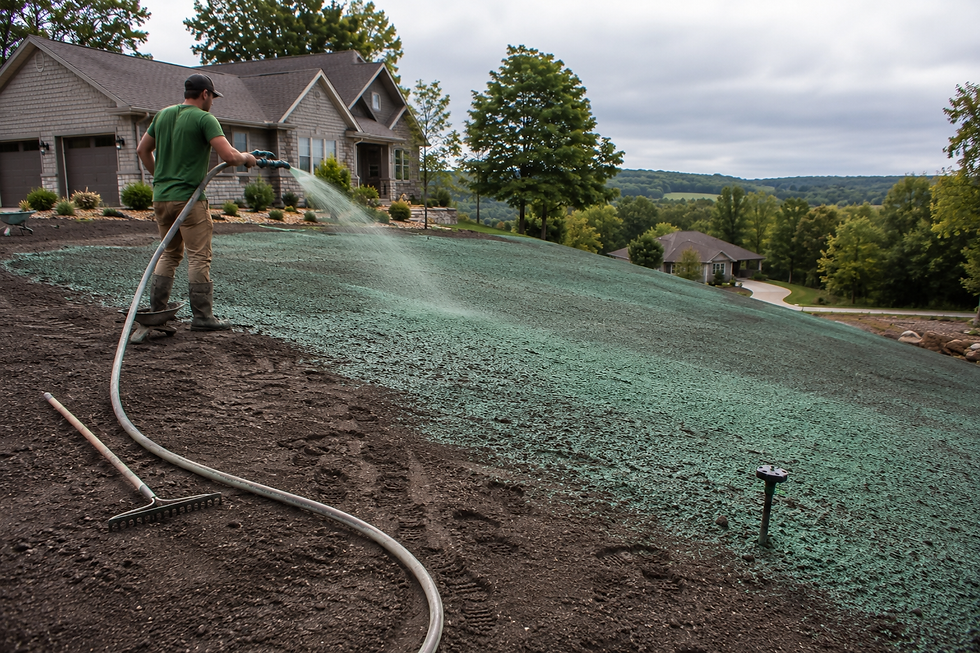
Those conditions can make hydroseeding an excellent option because the mulch component helps protect seed and soil during establishment. However, steep or erosion-prone areas may require additional tackifier, heavier mulch application, or erosion-control blankets.
August thunderstorms can deliver substantial rainfall in a short period.
A newly hydroseeded slope that receives a heavy storm before roots develop can experience washouts even when the installation itself was done correctly.
Proper finish grading and erosion planning should therefore be addressed before the lawn is sprayed.
Should You Hydroseed Before or After Final Grading?
Always complete the necessary grading first.
Hydroseeding should be one of the final steps of a new lawn project.
If you are still planning patios, retaining walls, drainage work, trenching, or major construction, those projects should generally be completed before hydroseed is installed.
Heavy equipment traveling across a newly seeded lawn can destroy the seedbed.
The final surface should be smooth enough for future mowing while still maintaining appropriate drainage away from buildings.
If additional topsoil is necessary, that should also be installed and finish-graded before hydroseeding.
How Much Does Hydroseeding Cost in Decorah IA?
Hydroseeding is generally less expensive than sod when covering a large property.
For residential projects in northeastern Iowa, homeowners can reasonably use approximately $0.08 to $0.25 per square foot as a broad planning range for hydroseeding itself. Actual contractor pricing depends on project size, seed mixture, accessibility, slope, travel, and materials.
At that range, a straightforward 5,000-square-foot lawn might cost roughly $400 to $1,250 for hydroseed.
A 10,000-square-foot property could roughly fall between $800 and $2,500.
These are planning ranges rather than guaranteed quotes.
Additional services can increase the total project price, including:
Finish grading
Existing vegetation removal
Imported topsoil
Soil amendments
Erosion-control blankets
Additional tackifier for slopes
Difficult equipment access
Hauling or disposal
Larger open areas often have a lower effective cost per square foot than very small jobs because equipment setup and mobilization costs are spread across more square footage.
Is August Hydroseeding Cheaper Than Spring?
Not necessarily from a contractor pricing standpoint.
The financial advantage of late-summer hydroseeding comes from establishment conditions rather than an automatic seasonal discount.
A lawn installed at the right time may require fewer repairs and less intervention than one established during difficult growing conditions.
Spring is still a viable hydroseeding period, but spring turf competes with germinating weeds and can encounter very wet soil.
August offers warm soil and, particularly later in the month, increasingly favorable temperatures for cool-season grass.
What If August Is Extremely Hot?
You can still hydroseed, but irrigation becomes more important.
If temperatures are unusually high, the seedbed can dry rapidly during the afternoon. Sunny slopes and areas near concrete or retaining walls are particularly vulnerable.
Multiple light watering cycles may be required.
The key is preventing the seedbed from drying without applying enough water to cause runoff.
If reliable watering is not available, delaying the project until conditions moderate may provide better results than hydroseeding during extreme heat and hoping for rain.
Will August Hydroseed Be Established Before Winter?
When installed at the appropriate time and cared for properly, it should have a strong opportunity to establish.
This is precisely why Iowa's recommended late-summer seeding window begins around mid-August.
The risk increases when installation is pushed too far into fall. Germination alone is not enough—the young turf needs growing time after emergence.
Weather varies from year to year, so there is no exact calendar date that guarantees success.
Starting during the recommended window gives the lawn considerably more flexibility.
Frequently Asked Questions
Is August too hot to hydroseed in Decorah?
Not necessarily. Early August can require intensive watering, but conditions generally improve later in the month. Mid-August into September is an excellent lawn-seeding period in Iowa.
What is the best time in August to hydroseed?
The second half of August is generally preferable because soil remains warm while air temperatures begin moderating.
How often should I water August hydroseed?
Water frequently enough to keep the seedbed consistently moist during germination. Hot, sunny conditions may require multiple short watering cycles per day.
Can I hydroseed a slope in Decorah?
Yes. Hydroseeding is commonly used on slopes, but steep or erosion-prone areas may require additional tackifier, mulch, or erosion-control blanket.
What happens if it rains after hydroseeding?
Light to moderate rain can be beneficial. Heavy rainfall can create runoff and wash seed or mulch from slopes before roots establish.
Is September better than August for hydroseeding?
Both can be excellent. Late August provides warm soil and gives the grass additional establishment time before winter. Early September also offers favorable conditions.
How much does hydroseeding cost in Decorah IA?
A broad planning range is approximately $0.08 to $0.25 per square foot for hydroseeding itself, depending on size, materials, accessibility, and site conditions. Preparation is additional when needed.
Is hydroseeding cheaper than sod?
Usually. Hydroseeding has a lower upfront cost per square foot, particularly on large lawns. Sod costs more but provides an established lawn immediately.
Do I need topsoil before hydroseeding?
Not every property needs additional topsoil. If the existing soil is compacted, rocky, extremely poor, or insufficient for final grading, adding quality topsoil may improve establishment.
Schedule August Hydroseeding in Decorah IA
August is not too late for a new lawn. In fact, mid-August into early September is one of the strongest periods of the year to establish cool-season grass in Iowa.
The best results still depend on preparation and aftercare.
Your lawn should be properly finish-graded, drainage problems should be addressed, and you should have a reliable watering plan ready before hydroseed is applied. For Decorah properties with significant slopes, erosion control should also be considered before installation.
Decorah Sod & Hydroseed provides hydroseeding, sod installation, finish grading, soil preparation, and new lawn establishment throughout the Decorah area.
Contact Decorah Sod & Hydroseed today for a quote. We'll review your property, lawn size, preparation needs, and timeline to determine whether August hydroseeding is the right option for your project.


Comments